






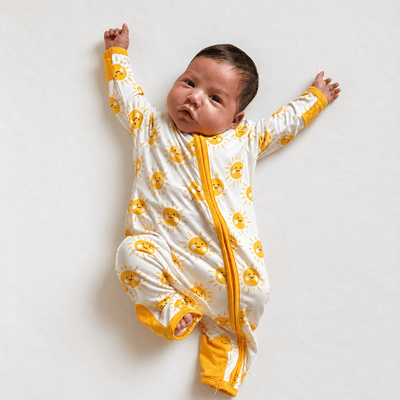
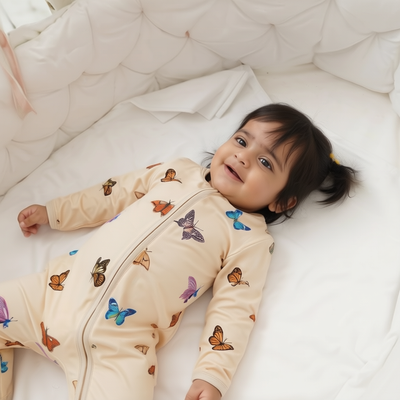

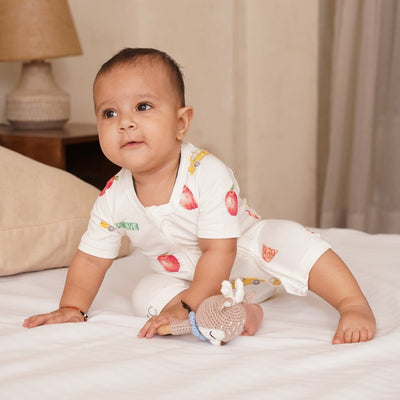



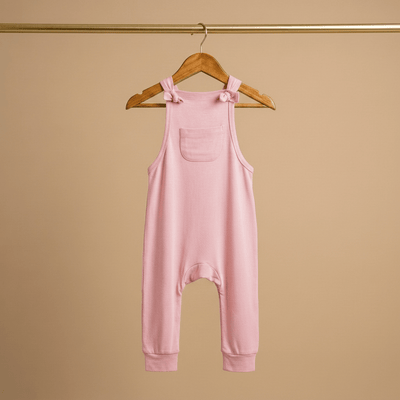




Sleep is the single thing new mothers in India search for at 2 a.m. more than anything else. How many hours should my newborn sleep, why is mine waking every 45 minutes, when will this end, am I doing something wrong. This newborn sleep guide for India is here to give you grounded, evidence-based answers, with a focus on what works in an Indian home where the room may be 30°C, where grandparents live with you, and where co-sleeping is the cultural norm rather than the exception.
The good news is that almost everything you are worrying about is normal newborn sleep behaviour. Most babies are not sleeping through the night until somewhere between four and six months, sometimes later. Most newborns wake every 45 to 90 minutes. None of this means you are doing it wrong. What does matter is that your baby sleeps safely, in the right clothing for the weather, and that you slowly build a rhythm that you can actually sustain. At Bubz, we make bamboo zipsuits and bodysuits specifically because Indian summers make sleep clothing one of the most important and most ignored decisions for newborn sleep.
How Much Sleep Does a Newborn Actually Need?
Newborn sleep needs change quickly in the first six months. The numbers below are guidance from the American Academy of Pediatrics and broadly mirrored by the Indian Academy of Pediatrics. Your baby may sleep a little more or less than this and still be perfectly normal.
Sleep hours by age (0 to 6 months)
From 0 to 1 month, newborns typically sleep 14 to 17 hours in 24 hours, broken into stretches of 2 to 4 hours at a time. There is no clear day-night pattern yet. From 1 to 3 months, total sleep stays around 14 to 16 hours, but stretches start to lengthen at night and shorten during the day. From 3 to 6 months, total sleep drops to about 12 to 15 hours, with the longest stretch usually at night and three to four daytime naps.
Why your newborn sleeps so much, then so little
In the first weeks, your baby is genuinely exhausted by the work of being alive outside the womb. By six to eight weeks, alertness increases and sleep starts to organise around feeding cycles. The shift can feel sudden. A baby who used to sleep four hours straight may suddenly wake every two. This is developmental, not a problem.
When sleep starts to consolidate
Most babies start sleeping longer stretches at night between 12 and 16 weeks. By six months, many but not all babies sleep one stretch of 6 to 8 hours overnight. "Sleeping through the night" in paediatric terms means a 5-hour stretch, not 12 hours. Adjust your expectations accordingly.
Newborn Sleep Cycles (And Why They Are So Different from Adult Sleep)
A newborn sleep cycle is about 45 to 60 minutes long. An adult sleep cycle is about 90 minutes. Newborns also spend roughly half of their sleep in active sleep, the newborn equivalent of REM, during which they twitch, grimace, vocalise, and look like they are about to wake up.
Active sleep is not waking up
When your baby grunts, flutters their eyelids, or makes small noises every hour, they are almost certainly in active sleep, not actually waking. Resist the urge to pick them up immediately. Wait two or three minutes. Many of these moments resolve on their own and your baby drifts back into deeper sleep.

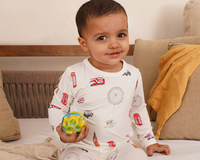
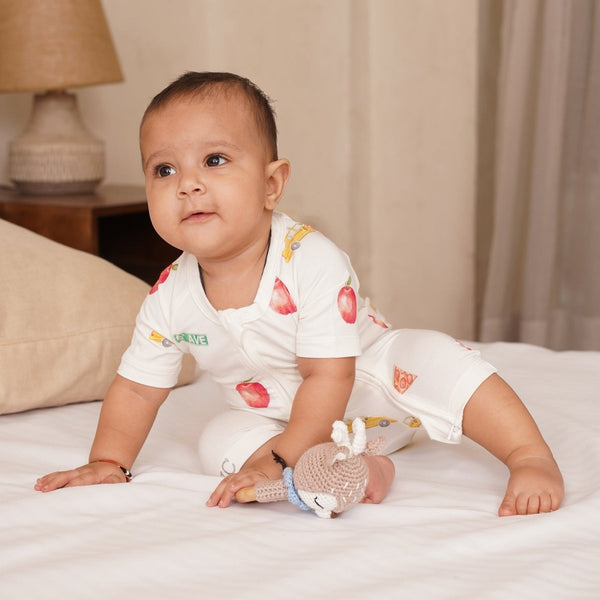
London Bamboo Zipsuit
Rs. 2,200
Why newborns wake every 45 to 60 minutes
Short cycles are a biological feature, not a bug. Newborns wake frequently partly because they need to feed often and partly because frequent waking is protective against Sudden Infant Death Syndrome (SIDS). Cycle length increases gradually over the first six months.
What changes around four months
At roughly four months, your baby's sleep cycles mature toward an adult-like pattern with clearer light and deep stages. This shift is sometimes called the 4-month sleep regression, and it often feels like sleep gets worse before it gets better. It is developmental and temporary.
Safe Sleep Practices Every Indian Parent Should Know
Safe sleep is the single area where evidence is strongest and culturally contested in India. Here is what the global paediatric guidance says, with notes on how it applies in Indian homes.
The ABC of safe sleep
The international standard is Alone, on the Back, in a Crib. Alone means without pillows, soft toys, loose blankets, or other people in the same sleep surface. On the back means your baby should always be placed to sleep on their back, never on the stomach or side, until they can roll independently in both directions. In a crib means a firm, flat sleep surface free of soft bedding.

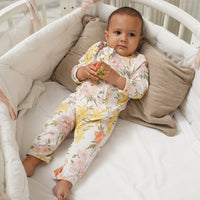
Under the Sea Bamboo Zipsuit
Rs. 2,200
Room sharing vs bed sharing in Indian homes
Room sharing, where your baby sleeps in a separate cot or bassinet in the same room as you, is recommended for at least the first six months and is associated with a 50 percent reduction in SIDS risk. Bed sharing, where your baby sleeps on the same surface as parents, is common in India but increases SIDS risk and is not recommended by paediatric guidance. If you do choose to bed share, the safer setup is a firm mattress, no loose covers, no pillows near the baby, and never on a sofa or armchair.
Mattress, bedding, and overheating risks in Indian summer
Use a firm mattress with a fitted sheet. No bumpers, no pillows, no quilts, no soft toys until well past the first birthday. Overheating is a real SIDS risk factor and matters especially in Indian summer. A baby should feel comfortably warm to the touch on the chest or back of the neck, not hot or sweaty.
Swaddling: when to start, when to stop
A snug swaddle in the first weeks can help your newborn sleep longer by containing the startle reflex. Use a light, breathable fabric such as muslin or bamboo. Stop swaddling as soon as your baby shows any sign of rolling, which is usually between 2 and 4 months.
What Should Your Newborn Wear to Sleep in India?
Sleep clothing is one of the most overlooked variables in newborn sleep and one of the easiest to get right.

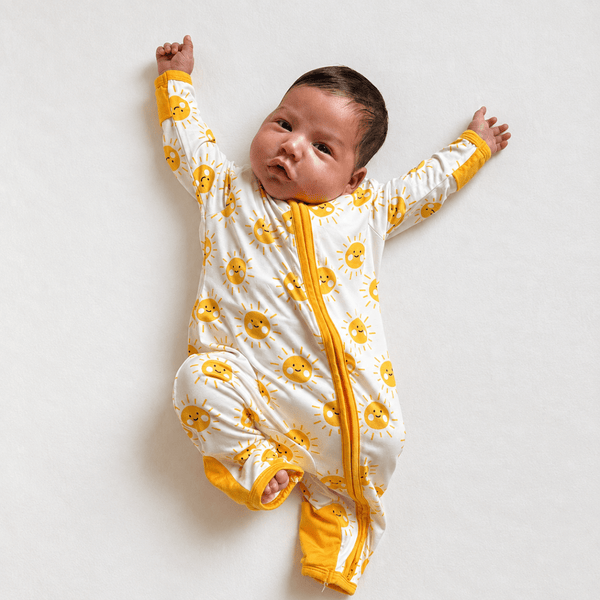
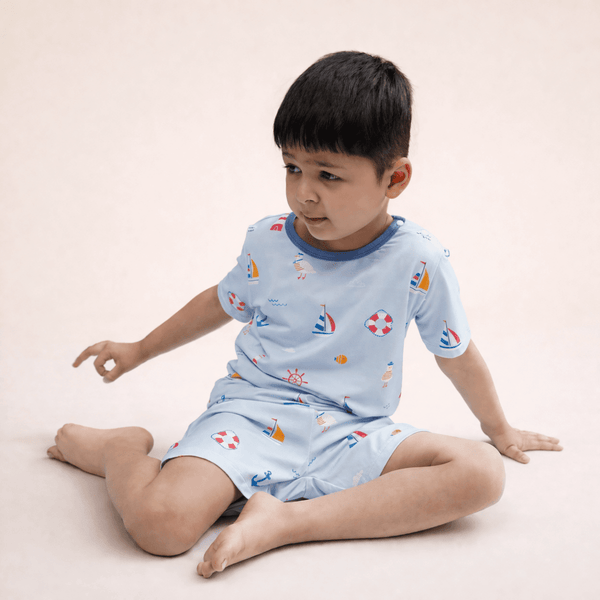
Beach Bamboo Zipsuit
Rs. 2,200
Match clothing to room temperature
In a 26 to 30°C room (typical of a non-AC Indian summer bedroom), a single layer of breathable bamboo such as a short-sleeve bodysuit or a light bamboo zipsuit is usually enough. In a 22 to 24°C air-conditioned room, a long-sleeve bamboo zipsuit is often the right choice. If your room dips below 22°C, add a light bamboo sleep sack on top of the zipsuit.
Why bamboo works for Indian sleep
Bamboo fabric is naturally moisture-wicking and roughly 3°C cooler than cotton, which means it keeps your baby in the comfortable range whether the AC is on or off through the night. It is also hypoallergenic, which matters if your baby has eczema or sensitive skin. The Bubz bamboo range is OEKO-TEX Standard 100 certified at Product Class 1, the highest category for items in direct contact with infant skin.
Sleep clothes that make night feeds easier
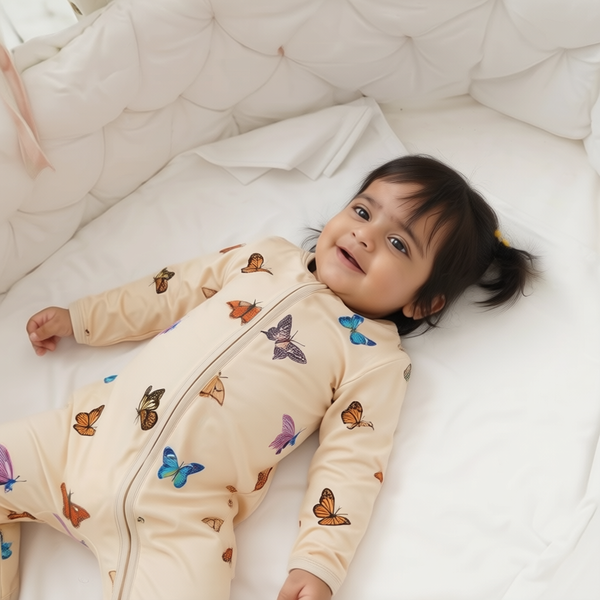
A two-way zip bamboo zipsuit opens from the bottom, which lets you do night nappy changes without unzipping the whole suit and waking your baby. This is the single most useful piece of clothing in the first three months of broken sleep. The envelope necklines on Bubz bodysuits also come on and off in seconds for the inevitable middle-of-the-night outfit change after a leak or a spit-up.
How to Build a Newborn Sleep Routine (Without Sleep Training)
In the first three months, your baby is too young for formal sleep training. What you can do is set up cues and rhythms that make sleep more likely.
Wake windows by age
The wake window is how long your baby can comfortably stay awake between sleeps. From 0 to 1 month, wake windows are 45 to 60 minutes. From 1 to 3 months, 60 to 90 minutes. From 3 to 6 months, 90 minutes to 2 hours. Pushing past wake windows is the most common reason newborns become overtired and harder to settle.
Reading sleep cues
Yawning, eye-rubbing, ear-pulling, glazed staring, and turning the head away are early sleep cues. Fussiness, arching the back, and crying are late cues. Aim to start the settling routine at early cues, before your baby tips into overtired territory.
The drowsy-but-awake principle
For the first few weeks, it is normal and fine to feed or rock your baby to sleep. From around six to eight weeks, you can start practising laying your baby down drowsy but still awake for some sleeps. This builds the skill of falling asleep independently, which becomes useful later. Do not force it. If your baby cries hard, pick them up.
Day-night confusion and how to fix it
Newborns are often "backwards" on day and night in the first weeks. Help reset this by keeping daytime feeds bright and chatty, and keeping night feeds dim and quiet. Open blinds during the day. Use a small night light, not the main light, for night feeds and nappy changes. This typically resolves within two to three weeks.
Common Newborn Sleep Problems (and What Actually Helps)
Catnapping, where your baby naps only 30 to 45 minutes at a time during the day, is normal and frustrating. Most babies start consolidating naps closer to 4 to 6 months. In the meantime, focus on total daytime sleep, not nap length.
The 4-month sleep regression is a permanent change in sleep architecture that often manifests as more night wakings, shorter naps, and increased fussiness for two to six weeks. Do not introduce major changes during the regression. Hold your safe sleep environment and your routine steady, and it will settle.
Reflux can cause babies to wake often or resist lying flat. If you suspect reflux, talk to your paediatrician. In the meantime, hold your baby upright for 20 to 30 minutes after feeds and avoid overfeeding.
Teething typically begins between 4 and 7 months. It does disrupt sleep but rarely as dramatically as parents assume. If your baby's sleep is significantly disturbed for more than a few nights, it is worth checking other causes first.
When to Talk to Your Paediatrician About Sleep
Most newborn sleep concerns are normal, but some warrant a call. Persistent difficulty waking your baby for feeds, very loud or laboured breathing during sleep, blue lips or face, extreme sweating throughout the night without obvious heat reason, or sleep that suddenly changes dramatically without an obvious developmental cause are all worth a paediatrician's attention.
Conclusion
A newborn sleep guide for India needs to live with the reality of warm bedrooms, joint families, and the cultural norm of close sleep arrangements. The principles that matter most are clear. Place your baby on their back, on a firm flat surface in your room, dressed in a light breathable layer such as a bamboo zipsuit, with nothing soft in the sleep space. Watch wake windows, respond to sleep cues, and trust that consolidation will come somewhere between four and six months.
If you are building your newborn sleep setup from scratch, the Bubz newborn bundle covers the bamboo zipsuits and bodysuits that will see your baby through the first six months of sleep, day and night. And if you are gifting for a baby shower, our bamboo gifting collection is built around exactly this stage.
FAQ
How many hours should a newborn sleep in 24 hours?
A newborn from 0 to 1 month typically sleeps 14 to 17 hours across 24 hours, in short stretches of 2 to 4 hours. From 1 to 3 months, total sleep stays around 14 to 16 hours but night stretches get longer. From 3 to 6 months, total sleep is roughly 12 to 15 hours with one longer stretch overnight and three to four daytime naps.
Is it safe to co-sleep with my newborn in India?
Room sharing, where your baby sleeps in a separate cot or bassinet in the same room as you, is recommended by paediatric guidance and is associated with a significant reduction in SIDS risk. Bed sharing on the same surface as parents is common in India but is not recommended by global paediatric bodies because it increases SIDS risk. If you do bed share, use a firm mattress, no loose covers, no pillows near the baby, and never on a sofa or armchair.
What should I dress my newborn in for sleep in Indian summer?
In a 26 to 30°C non-AC room, a single layer of breathable bamboo (a short-sleeve bodysuit or light bamboo zipsuit) is usually enough. In a 22 to 24°C AC room, a long-sleeve bamboo zipsuit is appropriate. Avoid loose blankets and prefer a fitted zipsuit or sleep sack. Check your baby's chest or back of the neck. They should feel comfortably warm, not hot or sweaty.
When do babies start sleeping through the night?
Most babies start sleeping longer stretches at night between 12 and 16 weeks. By six months, many but not all babies sleep one stretch of 6 to 8 hours overnight. In paediatric terms, "sleeping through the night" means a 5-hour stretch, not 12 hours. Some perfectly healthy babies do not sleep through until well past their first birthday.
Should I swaddle my newborn for sleep?
A snug swaddle in light, breathable fabric such as bamboo or muslin can help newborns sleep longer by containing the startle reflex. Stop swaddling as soon as your baby shows any sign of rolling, typically between 2 and 4 months. Swaddling a baby who can roll significantly increases the risk of suffocation.
Radha Joshi writes about bamboo baby clothing, infant care, and practical parenthood for Bubz India.
Radha Joshi writes about bamboo baby clothing, infant care, and practical parenthood for Bubz India.